
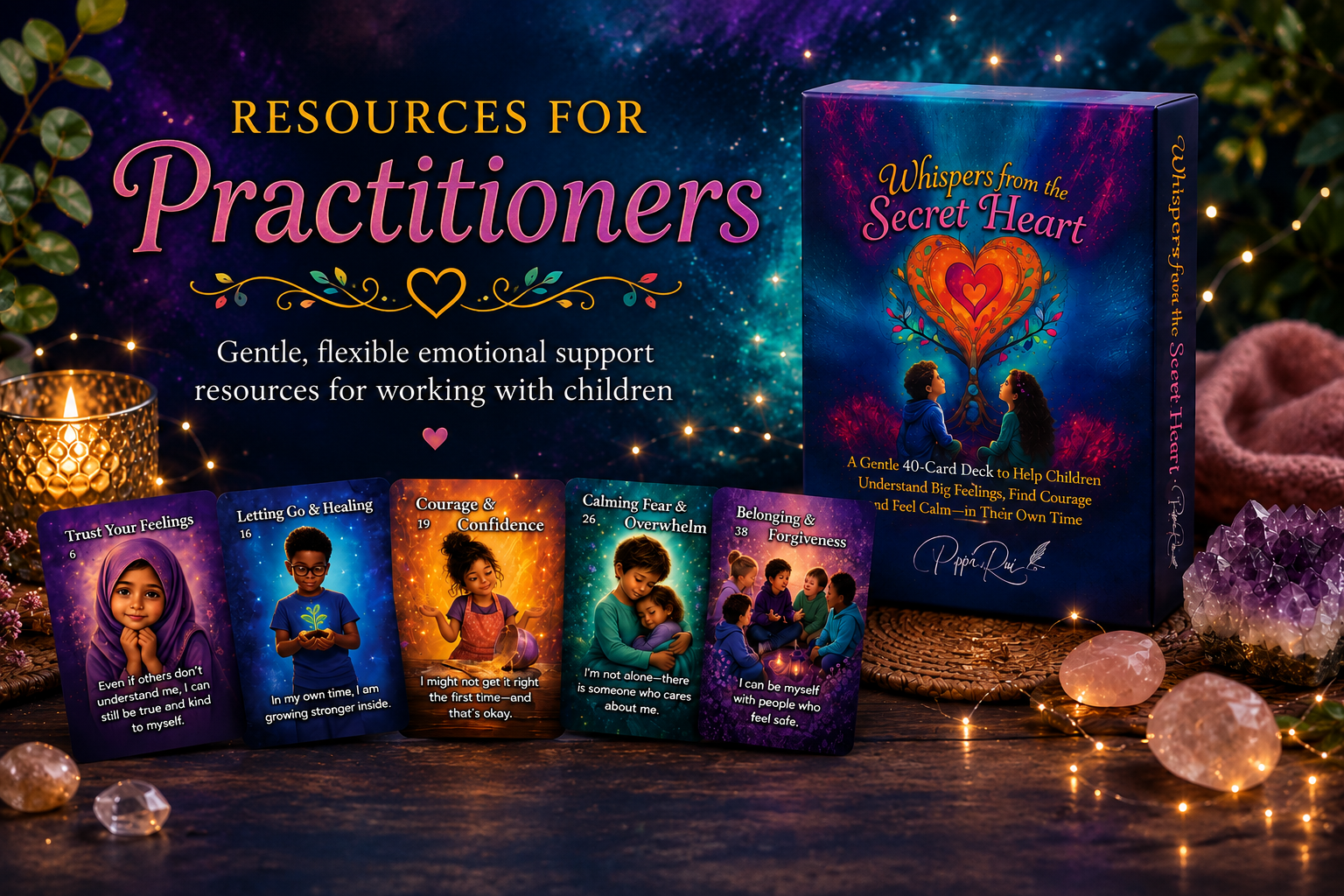
Gentle, flexible ways to support children as they explore feelings, confidence and emotional wellbeing.
Whispers from the Secret Heart is a 40-card emotional support deck plus 6 introductory cards, created to offer practitioners a gentle way to explore feelings, confidence, connection and emotional wellbeing with children. Each card combines a reassuring message with a child-friendly reflection and a simple Some Ideas suggestion, providing opportunities for conversation, reflection or quiet individual engagement.
Designed to be flexible rather than prescriptive, the cards can be introduced in ways that complement a practitioner's own approach and the individual needs of the child. There is no required order, no expectation to complete an activity and no need for a child to explain or disclose their feelings for a card to have value.
Areas of Emotional Support
The 40 cards are organised across five themes, offering practitioners flexibility to select cards that may be relevant to the individual child and the focus of a particular session.
Trust Your Feelings — exploring emotional awareness, self-trust and recognising that feelings can provide useful information about what may be happening inside.
Letting Go & Healing — gently opening space around hurt, loss, change and difficult experiences, while recognising that healing can happen gradually and in different ways.
Courage & Confidence — supporting conversations around self-belief, trying again, uncertainty and finding courage without placing pressure on a child to feel or behave a particular way.
Calming Fear & Overwhelm — helping children notice experiences of fear or overwhelm and explore simple, gentle strategies that may help them feel more settled.
Belonging & Forgiveness — exploring connection, acceptance, relationships, boundaries, misunderstandings and repairing connections while still respecting a child's own feelings and needs.
Ways to Use the Cards in Practice
Let the child choose — spread out several cards or allow a child to browse the deck and see whether one catches their attention. There doesn't need to be a reason for their choice or an expectation that they explain it.
Select a card gently — a practitioner may notice that a particular card connects with something being explored and offer it as an option: “I found this card and wondered what you thought of it.” The child remains free to engage with it or leave it aside.
Begin with the image — sometimes looking at the child pictured on a card can feel easier than talking directly about personal feelings. A practitioner might begin by wondering what the child in the illustration could be thinking or feeling and allow the conversation to develop naturally.
Use the reflection as an opening — the reflection on the back of each card can provide a starting point for conversation without requiring the child to answer a direct personal question.
Explore the “Some Ideas” suggestions — if something on the card appeals to the child, the practitioner and child might explore one of the Some Ideas suggestions together. They are possibilities to consider rather than activities that need to be completed.
Use a card when words are difficult — a child may find it easier to point to, hold or choose a card than explain what is happening for them. The card can provide another way to communicate without requiring immediate verbal expression.
Revisit a card — a child may connect with a particular card and choose to return to it over several sessions. Its meaning may change as their experiences and understanding change.
Simply leave space — not every card needs to lead to a discussion or activity. Sometimes reading a reassuring message, looking at an image or sitting with an idea may be enough.
Designed with Different Children in Mind
Whispers from the Secret Heart has been thoughtfully created with an understanding that children experience emotions, communication and support in different ways. The cards use gentle, choice-based language and have been designed to be inclusive of neurodivergent children, including autistic children, children with ADHD and those with a PDA profile.
Rather than asking a child to identify, explain or change how they feel, the cards offer possibilities. Reflections are presented gently, and the Some Ideas section provides options a child may choose to explore — or simply leave aside.
There is no “right” way to use a card. A child may want to talk about it, look at the illustration, read the words, choose an idea, hold onto a particular card or decide that it isn't for them. Their level of engagement can remain their choice.
The same low-pressure approach can also be helpful for children who need more processing time, find direct questions uncomfortable, communicate in different ways or simply respond better when they are given space and autonomy.